almagrosherri

Army Volunteer Corps Fort Bragg

Army Volunteer Corps (AVC) Overview

Volunteering is a defining part of the American experience. From the Minutemen at Lexington to today’s all-volunteer force, the Army relies on the fundamental connection between volunteerism and citizenship. The strength of the Army lies in its Soldiers, and the strength of Army communities lies in the talents and contributions of its members. Volunteerism stabilizes our Army communities by contributing to community cohesion, increasing self-reliance, and enhancing the well-being of our Soldiers and their families. The Army relies on volunteers to contribute to the well-being of Soldiers, civilians, and families.

VMIS (Volunteer Management Information System) – Are you tracking?
Volunteers are required to be registered in the central database, as well as reporting hours each month.

Fort Bragg units/organizations are now online with the new Department of Army Volunteer Management Information System (VMIS) at Army One Source! You may search for volunteer opportunities, log your hours, and document training and awards all on one site.  The information travels with you when you PCS or ETS, and provides you with a complete volunteer history whether you’re just tracking your volunteer activities, or using the information to search for employment. Available volunteer opportunities can be found by accessing Army One Source.  Click on the “Volunteer Tools” tab (in the upper right-hand corner). Search by the community (Fort Bragg), and by an organization (the organization you wish to volunteer in).

Volunteer Manager Training Schedule
Training is offered throughout the year for those individuals in units, installation activities, and registered private organizations who manage volunteers. The various training opportunities provide knowledge/skills to enable you to manage your volunteers within the Army Volunteer Management Information System, write effective award nominations, understand the administrative and legal issues involved with managing Army Volunteers, etc. All training opportunities are open to Family Readiness Support Assistants (FRSA), Family Readiness Liaisons (FRL), Family Readiness Group (FRG) leadership, as well as agency/private organization volunteer coordinators.  Training is also open to commanders (to include rear detachment), senior spouses, etc. – anyone who wants to learn the ins and outs of managing Army volunteers.

Volunteer Manager Training Schedule (.pdf) – coming soon!

Current Off Post Volunteer Opportunities
Please stop by the office for a more detailed listing of opportunities in the local community.

  • North Carolina Veterans Park – Volunteers Needed! Located in historic downtown Fayetteville, this is the first state park dedicated to military veterans, young and old, living or deceased, from all branches of the Armed Services.  If you are interested in volunteering, contact Mr. Clyde V Vaughan, Volunteer Coordinator, NC State Veterans Park, +1 (910)822-4362, or +1 (910)366-2360, or email.
  • Fourth Friday – Every Month – Downtown Fayetteville! Visit The Arts Council for more information.
  • The Haven – Animal Rescue – Various volunteer opportunities available.
  • Guardian Ad Litem – Be an Advocate for a Child!
  • Urban Farming Tour Docents  – Interested in learning more about organic farming, or even volunteering to be a tour docent for one of the locations in Cumberland or Moore County?  Visit Sustainable Sandhills for more information. You may also contact Heather Brown via email or call +1 (910)639-7024.
  • Arts Council – For more information on the Arts Council and volunteer opportunities, visit The Arts Council.
  • International Folk Festival in downtown Fayetteville is looking for volunteers! Visit The Arts Council to figure out how you can help.
  • MDA Camp Needs You!!! The Muscular Dystrophy Association Summer Camp is often referred to as “the best week of the year”. Our camp is unique because we’re able to offer a week of barrier-free fun, where there are virtually no limitations. Activities include zip lines, archery, horseback riding, swimming, fishing and so much more. Each camper is paired with a counselor of the same gender for the entire week. The duo takes part in all activities as a team, and the counselor may be called upon for assistance with daily living activities. While we are happy to accept applications from interested females, OUR GREATEST NEED IS FOR MEN SINCE ABOUT 70% OF OUR CAMPERS ARE MALE! We provide training before the campers arrive so that our counselors feel comfortable working with their campers for the week. Visit Ultra Camp to register as a volunteer.
  • Pet Foster Families Resources
VMIS Registration Incentives
New incentives (.jpg) available just for registering and logging hours!

Registration is important to your unit/organization chain of command, and the installation. It provides valuable information on the number of volunteers, the types of work volunteers are performing, and the amount of time worked. This information provides the command with the big picture as to how our volunteers are supporting our Soldiers, their Families, and the mission.

As part of the Bragg Bucks Program, when you register in VMIS and log your hours each month, your hours can be “cashed” in for various items such as totes, portfolios, tumblers, etc. Hours must be entered during the current open period, and logged appropriately by day and not by period. Only hours logged for Fort Bragg units/organizations since October 2009 count toward the program.

Each volunteer registered in VMIS and logging hours can also earn a lapel pin for every 250 hours documented.  The basic lapel pin is earned with the initial 250 hours, and then wings are added for each additional 250 hours.  Wings are available in increments of 250 hours through 2,500 hours. Pins are available to pick up at the AVC office at any time after you reach each individual goal.  Hours must be certified by your OPOC prior to claiming your pin.

Can’t get into the office to pick up your pin? Email us (at the link at the top of the page) with your name, organization, and mailing address. As long as the information is properly inputted into VMIS, we can verify it and drop your pin in the mail within a few days!

Iron Mike Awards Ceremony Photos
Photos taken at the Iron Mike Awards Ceremonies will be made available shortly after the ceremony and can be found on the Fort Bragg ACS Flickr page.
Types of Volunteers
Installation volunteers fall into three categories:  statutory, private organization, and gratuitous service.

  • Statutory volunteers are those volunteers authorized by federal statute (10 USC 1588) to provide services in certain Department of Defense activities such as MWR, family programs, museums, chaplain, child care, etc.  Statutory volunteers, when acting within the scope of their position description, are provided certain benefits by law such as worker’s compensation.
  • Private organization volunteers are part of non-federal entities authorized to operate on the installation.  These organizations contribute to the overall installation mission, but their volunteers are not considered statutory.  All liability for incidents/accidents or injury to the volunteer is the responsibility of the private organization.
  • Gratuitous service volunteers provide services to organizations not covered under the federal statute and do so with no expectation of compensation or benefit coverage.
Applicable Volunteer Policies and Regulations
Required Volunteer Registration Forms
Per AR 608-1, all statutory volunteers must register, complete a volunteer agreement, and have a position description PRIOR to starting work. In addition, the regulation requires volunteers to document all hours worked.  Registration in the VMIS at Army One Source eliminates the need for the following forms:

  • Don’t Need DA 4162, Volunteer Service Record (generated when registered in VMIS)
  • Don’t Need DA 4713, Volunteer Daily Time Record (generated when registered in VMIS)
  • Need DD Form 2793, Mar 2018 (.pdf)*
    This form is position-specific and must be signed by the volunteer and the unit/organization accepting official prior to starting work. A separate DD Form 2793 must be completed/signed for each statutory activity in which the volunteer works. The original must be maintained in the unit/organization files, and a copy uploaded to VMIS in the Volunteer VSR under the Files Tab. The DD Form 2793 is not applicable to private organizations or gratuitous service volunteers.*This version (Mar 2018) replaces the May 2009 version. New forms do not have to be completed unless the volunteer position in the organization has changed.
Award Information & Nomination Forms

Army Volunteer Corps Fort Bragg Read More »
Survivor Outreach Services Fort Bragg

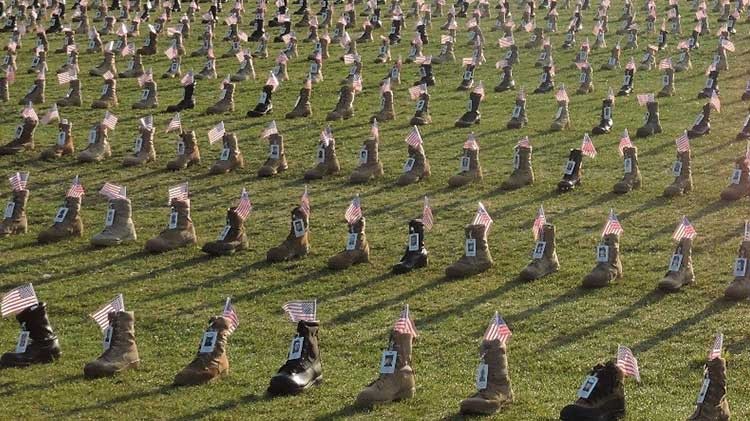
Our Fallen Soldiers have paid the ultimate sacrifice. Families deserve our respect, gratitude, and the very best we can provide. If you’re a surviving Family member, Survivor Outreach Services (SOS) offers you access to support, information, and services, closest to where you live, when you need it, and for as long as you need it.

Survivor Outreach Services is part of the Army Casualty Continuum of Care. It’s designed to provide long-term support to surviving Families of Fallen Soldiers. Our goal is to reassure Survivors that they remain valued members of the Army Family.

Survivor Outreach Services helps in many ways:

  • Support Coordinators. The loss of a loved one often results in tremendous grief, which can be overwhelming. When faced with a tragedy, you may be wondering what direction to take. Your SOS Coordinator is your link to finding the resources and answers that will work best for you. Your local Support Coordinator is available to meet with you as you journey through this difficult transition by providing direct services as well as information, referrals, and recommendations. He or she can also connect you with support groups, spiritual resources, and bereavement, and financial counselors. Your SOS Coordinator can also help you request and obtain copies of documents, navigate local, state, and federal agencies, and direct you to additional Survivor resources.
  • Financial Counselors. In times of emotional distress, figuring out what to do about finances can create a heavy burden. Survivor Outreach Services Financial Counselors provide professional financial information and services in areas such as investing, estate planning, tax issues, and basic budgeting. Our Financial Counselors are committed to helping you create financial security. They also help ensure you get the information you need to make sound financial decisions.
  • Gold Star Advocates provide support and address complaints about casualty assistance or receipt of benefits.

For more information about Army Survivor Outreach Services, or to locate your nearest SOS Coordinator, call toll-free +1 (855)707-2769.

To learn about the symbols of honor surviving military families wear, visit www.GoldStarPins.org.

Survivor Outreach Services on Fort Bragg
The mission of Survivor Outreach Services (SOS) is to advocate on behalf of all families who have suffered the loss of a Soldier and to educate the community about the Survivor Outreach Services Program.

The program strives to build a unified support program that embraces and reassures Survivors that they are continually linked to the Army Family for as long as they desire.

We provide an avenue of resources to include support groups, bi-monthly newsletters, information briefs, and social activities.

For more information on Survivor Outreach Services on Ft. Bragg, contact the local SOS Coordinator at +1 (910)396-0384.

Support Groups
Support Group will be held on the 1st Thursday of every month at 10 a.m. Call us for more information at +1 (910)396-0384.
Newsletter and Events
Helpful Resources

Survivor Outreach Services Fort Bragg Read More »

Mobilization, Deployment, and SSO Fort Bragg

The Mobilization, Deployment, and Support Stability Operations (MDSSO) helps support community readiness during deployments and emergencies. We help make sure installation programs align with unit deployment cycles, provide pre- and post-deployment support, and help unit Commanders with their Family Readiness plans and deployment support services for Service Members and their Families. We’re responsible for operating an Emergency Family Assistance Center in the case of an all-hazards event, and supporting Service Members and Families during Non-Combatant Evacuation Operations (NEO) and Repatriation. We also act as a case manager for all requests for assistance through the Army Disaster Personnel Accountability and Assessment System (ADPAAS).

Some of our resources include:

  • Pre- and Post-Deployment Support: Helps prepare Soldiers and Families for deployments and reintegration by providing training and resources throughout the deployment cycle in a variety of settings.
  • Family Readiness GroupsDesigned to make sure Families have the information they need and develop a military support group while their Soldier is deployed. Virtual Family Readiness Groups also provide secure environments in which the Commander can communicate directly with Soldiers and Families 24 hours a day, no matter where they are.
  • Emergency Family Assistance: Your link to continuous support and assistance as well as authoritative and accurate information in a sensitive, timely, and effective manner.
  • Army Disaster Personnel Accountability and Assessment System (ADPAAS): Ensures all Army personnel and their dependents are accounted for during emergency situations.
  • NEO/Repatriation: We help the State Department help those who have been displaced after national emergencies and disasters.

For more information on Mobilization, Deployment, and Support Stability Operations support in your community, contact your local Army Community Service office and ask for the Mobilization and Deployment program manager or specialist.

Other helpful links:

  • Operation READY: “READY” stands for “Resources for Educating About Deployment and You.” It’s a training and information resource developed from lessons learned in the Persian Gulf War and used in Operation Iraqi Freedom (OIF) / Operation Enduring Freedom (OEF). The training covers learning about the types of military separation, planning and preparing personal documents, and completing family financial arrangements.
  • Comprehensive Soldier and Family Fitness (CSF2): Provides hands-on training and self-development tools so that members of the Army Family are better able to cope with adversity, perform better in stressful situations, and thrive in life.
  • Taking Care of Business: This video shares information that helps to deploy Soldiers make necessary arrangements to ensure that loved ones will be taken care of if the worst happens. It explains which forms and documents to complete before deploying to ensure that final wishes are observed.
  • Army OneSourceThis resourceful website provides information about deployment, reunion, finances, family, children’s workbooks and FRG. The download center allows you to research and download information that is important for you.

Classes

Please note that classes will be offered virtually until further notice. To register, please call +1 (910)432-3742. Registration will close 48 hours prior to the training date

Unit Briefings

Unit Briefings are available to prepare Soldiers and family members for deployment readiness. To start an online request, please visit the ACS Briefing Request. Please give 2 weeks’ notice for all brief requests.

Children & Deployment

Sgt. I. Mike’s Neighborhood presents…Kids Have Feelings, Too Puppet Show

What is the puppet show about?

The cast from SGT Mike’s Neighborhood (Rachel, Tommy, and SGT Mike) explore their feelings and learn how to deal with deployment and reunion issues that many military families go through with music, lights, and dance. We have three shows available:

  • SGT Mike’s Dance Warehouse (All deployment cycles)
  • Far Away (Pre-Deployment)
  • Coming Home (Reunion)

Who is the puppet show designed for?

Each one of the SGT I. Mike’s puppet shows is an extremely useful tool to help the children explore the many emotions and problems associated with all cycles of the deployment process. It was designed for children ages 4-12 years and their parents. Parents are required to attend the show to use as a gateway into a conversation about the deployment cycle with their child/children.

How long is the show?

The show runs for about 15 minutes.

Can I request the puppet show for my FRG?

Yes, you may submit a request at least two weeks in advance for Battalion level events and higher. The puppet show is high-tech so we will require an electrical outlet. If the event is being held outside, a level area is needed and a tent to cover the puppet stage. We will contact you 1 week and then again 2 days prior to the event for final confirmation.

Soldier and Family Readiness Group (SFRG)

Soldier and Family Readiness Group is a command sponsored organization of family members, volunteers, soldiers, and civilian employees belonging to a unit, that together provides an avenue of mutual support and assistance and a network of communications among the family members, the chain of command, chain of concern, and community resources. Visit our Soldier and Family Readiness Group (SFRG) Center webpage for more information.

Mobilization, Deployment, and SSO Fort Bragg Read More »

Airborne Attic

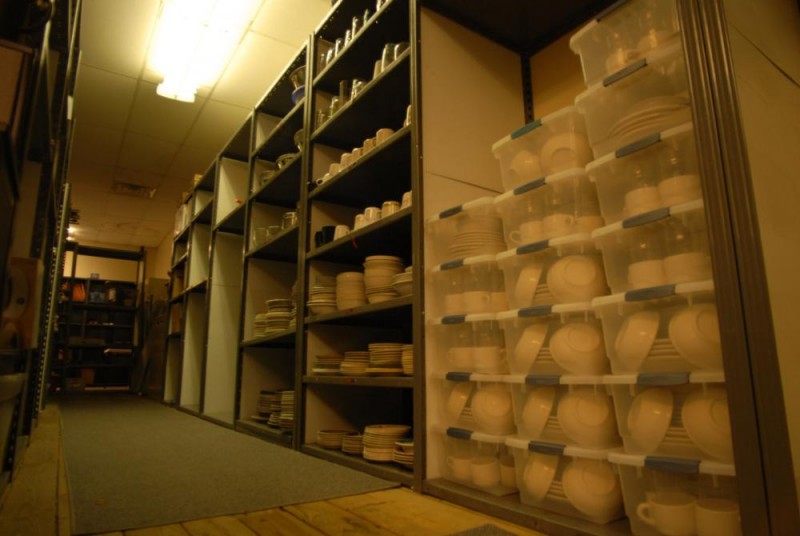
The Airborne Attic provides support for Soldiers and Family members (E-4 and below) at Fort Bragg with furniture, household goods, and baby items/clothing free of charge. Soldiers E-5 and above are allowed use in emergency situations with prior approval from the Relocation Readiness Manager.

The Airborne Attic operates completely from donations. Clean, in good usable condition items, are generously donated to the Attic from our Soldiers, Family members, businesses, organizations, and the local community. These items are inventoried and organized for distribution directly to Soldiers & Family members in need of assistance.

The Airborne Attic will pick up large donation items. Call us to schedule your large item donation pick-ups.

Commander’s Referral Letter to request assistance (.pdf)

Airborne Attic Read More »

Child Abuse Fort Bragg

What is Child Abuse and Neglect?
The Child Welfare Information Gateway describes child abuse as, “Any recent act or failure to act on the part of a parent or caretaker which results in death, serious physical or emotional harm, sexual abuse or exploitation; or an act or failure to act which presents an imminent risk of serious harm.” Child Abuse is categorized as follows: physical, emotional, sexual, and neglect.

  • Physical abuse is a non-accidental physical injury as a result of the beating, hitting, slapping, biting, etc. Physical discipline, such as spanking or paddling, is not considered abuse as long as it is reasonable and causes no bodily injury to the child.
  • Neglect is the failure of a parent, guardian, or another caregiver to provide for a child’s basic needs. Examples are failure to provide basic necessities such as food, clothing, basic medical care, or an egregious lack of age-appropriate supervision (i.e. leaving an infant unattended in a car).
  • Emotional abuse is a pattern of behavior that impairs a child’s emotional development or sense of self-worth. Examples include threatening, withholding love and affection, and telling a child that he or she is worthless.
  • Sexual abuse includes activities by a parent or caregiver such as fondling a child’s genitals, penetration, incest, rape, sodomy, indecent exposure, and exploitation through prostitution or the production of pornographic materials.
What are the consequences of Child Abuse?
While the physical wounds heal, there are several long-term consequences of experiencing the trauma of abuse or neglect. Abused children often are at risk of experiencing cognitive delays and emotional difficulties, among other issues. Childhood trauma also negatively affects the nervous system and immune system development, putting children who have been maltreated at a higher risk for health problems as adults.
What should I do if I suspect child abuse and/or neglect?
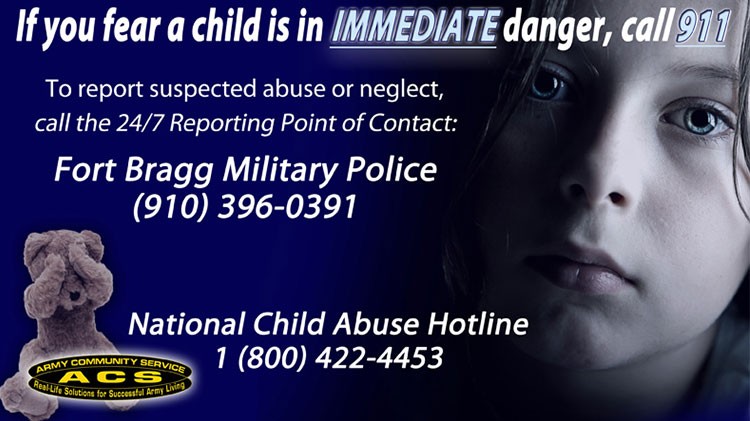
Off post: You should report your concerns to the appropriate authorities, such as child protective services (CPS) or local law enforcement. CPS has trained professionals who can evaluate the situation and determine whether help and services are needed. Following is a list of on post-off post agencies and contact information:

How can I help if I don’t suspect child abuse, but see a stressed-out parent with a child?
Child Help states, “We believe the key to preventing child abuse is education and awareness.” A stressed-out parent with a small child might benefit from a word of encouragement or offer of assistance. A word of understanding to a parent with a child in the middle of a tantrum can make a big difference. If the stressed-out parent is a friend, neighbor, or other acquaintance, offer assistance with a few hours of child care or household chores. Share community resources, such as parenting classes, stress, and anger management. For military families, call us for advice.
Can I leave my children home alone?
  • Children ages 0 years to 4th grade must have direct supervision at all times.
  • 5th and 6th-grade children must have monitored care for no more than two consecutive hours.
  • 7th and 8th graders may be under self-care for no more than four consecutive hours.
  • 9th and 10th graders may be under self-care for no more than six consecutive hours.
  • 11th and 12th graders may be under self-care for no more than ten consecutive hours.

Youth Babysitter: A child in grades 7-12 may provide direct supervision for non-siblings if they have completed the American Red Cross (ARC) Babysitter certification class or equivalent. Although strongly encouraged, a child in grades 7-12 need not have completed the ARC Babysitter certification class or equivalent to care for a sibling. A child in grades 7 or 8 will provide direct supervision for no more than four consecutive hours per day.

See the Fort Bragg Home Alone policy (.pdf) for more information.

I need help! What is available?
Good news! The Fort Bragg Family Advocacy Program (FAP) offers a number of excellent resources to assist Families with the complexities of raising children.

For expecting families and children up to 36 months, the New Parent Support Program (NPSP) offers free in-home visits to answer any questions you may have about childbirth and caring for infants and toddlers. In addition to free in-home visits, NPSP offers a variety of classes, including Infant Massage, Baby Basic Training, Play Mornings, Baby Sign, and more.

FAP offers a variety of parenting classes, such as 123 Magic, ScreamFree, Active Parenting, and Parenting 1-4. FAP also offers Parenting for Children of Divorce and Custody, Active Parenting for Step Families, and Couples Communication.

More good news! Not only does FAP offer free limited childcare, but Soldiers can also now receive promotion points for completing some of the FAP classes.

If you have any questions about parenting issues or Family problems, the Child Advocate trainers are available for non-therapeutic advice, consultation, and referrals.

Check out this Military One Source link for additional support regarding child abuse and neglect (and problematic sexual behavior of children and youth).

Child Abuse Fort Bragg Read More »